How-to · Research
How to use a bibliography generator in Chrome — no account, no uploads
The short answer
Instead of pasting URLs into a citation website, cite each source from the CiteRoam side panel as you read it. Every reference is formatted locally in APA, MLA, Chicago or Harvard and saved to a private library, so your works-cited list is ready when the paper is. Export BibTeX or RIS if you work in LaTeX or a reference manager.
- 1
On each page or PDF you use, open the CiteRoam side panel or press Alt+C.
- 2
Pick the style your assignment requires — APA, MLA, Chicago or Harvard.
- 3
Check the detected fields against the page, then keep the citation in your library.
- 4
When you write, copy each reference from the library into your works-cited list.
- 5
If you work in LaTeX or a reference manager, export the library as BibTeX or RIS instead.
Most bibliography generators are websites: you paste a URL, wait, close a cookie banner, and copy the result — and your source list accumulates on someone else's server. A generator that lives in Chrome inverts the workflow: you cite each source at the moment you're reading it, and the bibliography assembles itself in the background.
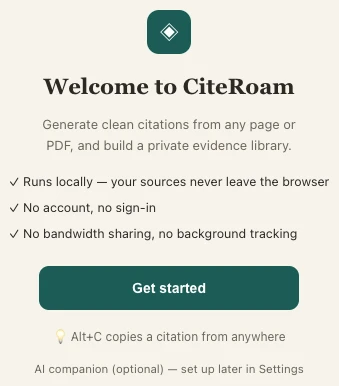
Cite as you read, not after
The classic failure mode of bibliography work is doing it last: you finish the draft, then try to reconstruct where each claim came from out of forty open tabs and a browser history. With CiteRoam you open the side panel (or press Alt+C) on each page or PDF while you're reading it, keep the citation, and move on. The reference list grows in step with the research, and PDFs you read in Chrome go into the same library as web sources.
Pick the style your assignment requires
References are formatted in APA, MLA, Chicago or Harvard, generated locally by Citation.js. Because the source data is saved — not just the formatted string — the same library serves a psychology paper in APA this term and a history essay in Chicago the next.
Check the fields, because pages lie
Any generator is only as good as the page's metadata, and pages routinely mislabel authors and dates. The citation card shows the fields it detected so you can verify them against the visible page before the entry enters your list. Thirty seconds per source here saves a round of corrections later.
Assemble the works-cited list
When you write, open the library in the side panel and copy each reference in your chosen style into the bibliography. Formatting details that belong to the document — hanging indents, line spacing — are applied in your word processor, as every style guide expects.
Export BibTeX or RIS when you outgrow copy-paste
If the project moves to LaTeX, or you later adopt a full reference manager like Zotero, export your library as BibTeX or RIS and import it there. The list you built while browsing carries over intact — your bibliography is never locked in.
No account, no upload
The library lives in your browser's local storage. There's nothing to sign up for, and the sources you collect are not sent anywhere.